How to choose
Choosing a cabin case that fits the airline you actually fly
Choose a cabin case that clears the airline you really use: external measurements including wheels, the empty weight that eats your allowance, and what the CAA says.

There is no single UK cabin bag size. The Civil Aviation Authority's passenger guidance states plainly that the amount and sizes of hand baggage you can take varies according to the airline and aircraft type, and that a bag too big or too heavy for the cabin may have to go in the hold, where there is likely to be a charge.
That makes this a buying decision with a moving target. The approach that works is to pick the tightest airline you fly more than twice a year, buy to that, and treat every other airline as slack. This guide works through the measurements, the empty weight, the wheels and the arithmetic of being caught at the gate.
Measure the case the way an airline measures it
Airlines size bags with a gauge at the gate, which means they measure the outside of the case including the wheels, the feet and the retracted handle housing. A maker's stated capacity in litres is irrelevant at that moment, and a stated size that quotes the body only will be several centimetres short of what the gauge sees.
Measure any case you own with a tape before you fly, from the outside of one wheel to the top of the retracted handle, and across the widest point of the lid, which on a soft case means over the front pocket when it is full. Write those three numbers on a label inside the lid. It takes 3 minutes and saves the whole argument.
Expansion zips are the trap. A case that measures correctly closed will not measure correctly expanded, and once you have used the expansion on the outbound leg you are carrying an oversized bag home. If you fly to a hard limit, buy a case without one rather than relying on your own restraint at the end of a holiday.
| Measurement | Taken from | What it stops going wrong |
|---|---|---|
| Height | Floor under the wheels to the top of the retracted handle | A case that is the right size until it is stood in a gauge |
| Width | Outside edge to outside edge at the widest point | Side feet and bumpers that add centimetres |
| Depth | Over the front pocket when it is packed | A soft case that passes empty and fails full |
| Empty weight | Bathroom scales, case empty, lid closed | An allowance half spent before anything goes in |
Measure with the case packed as you would fly, not flat and empty, because a soft shell gains depth under load.
Empty weight is a tax on everything you pack
A weight allowance is for the case and its contents together. A hard case that weighs 2.6 kg empty inside a 10 kg allowance leaves 7.4 kg for clothes; a lighter case at 1.9 kg leaves 8.1 kg. That 700 g difference is about 9% more packing, every single flight, for the life of the case.
This is where the usual advice to buy the toughest shell available breaks down. Extra weight buys crush resistance that matters in the hold and does very little in an overhead locker, so the right answer is genuinely different for a cabin case and a checked case. For cabin use, empty weight is the specification to optimise.
Put the case on bathroom scales before you buy if the shop lets you, because stated weights sometimes exclude the removable liner or the packing cubes that ship with it. Use the pack-weight calculator on this site to subtract the empty weight from your allowance and see what is genuinely left.
- 2.6 kg case in a 10 kg allowance leaves 7.4 kg of contents
- 1.9 kg case in the same allowance leaves 8.1 kg, about 9% more
- Across 6 flights a year that is the difference between repacking at the desk and not
- A removable liner or wash bag supplied with the case counts towards its empty weight
- Four spinner wheels typically add weight against two inline wheels of the same size
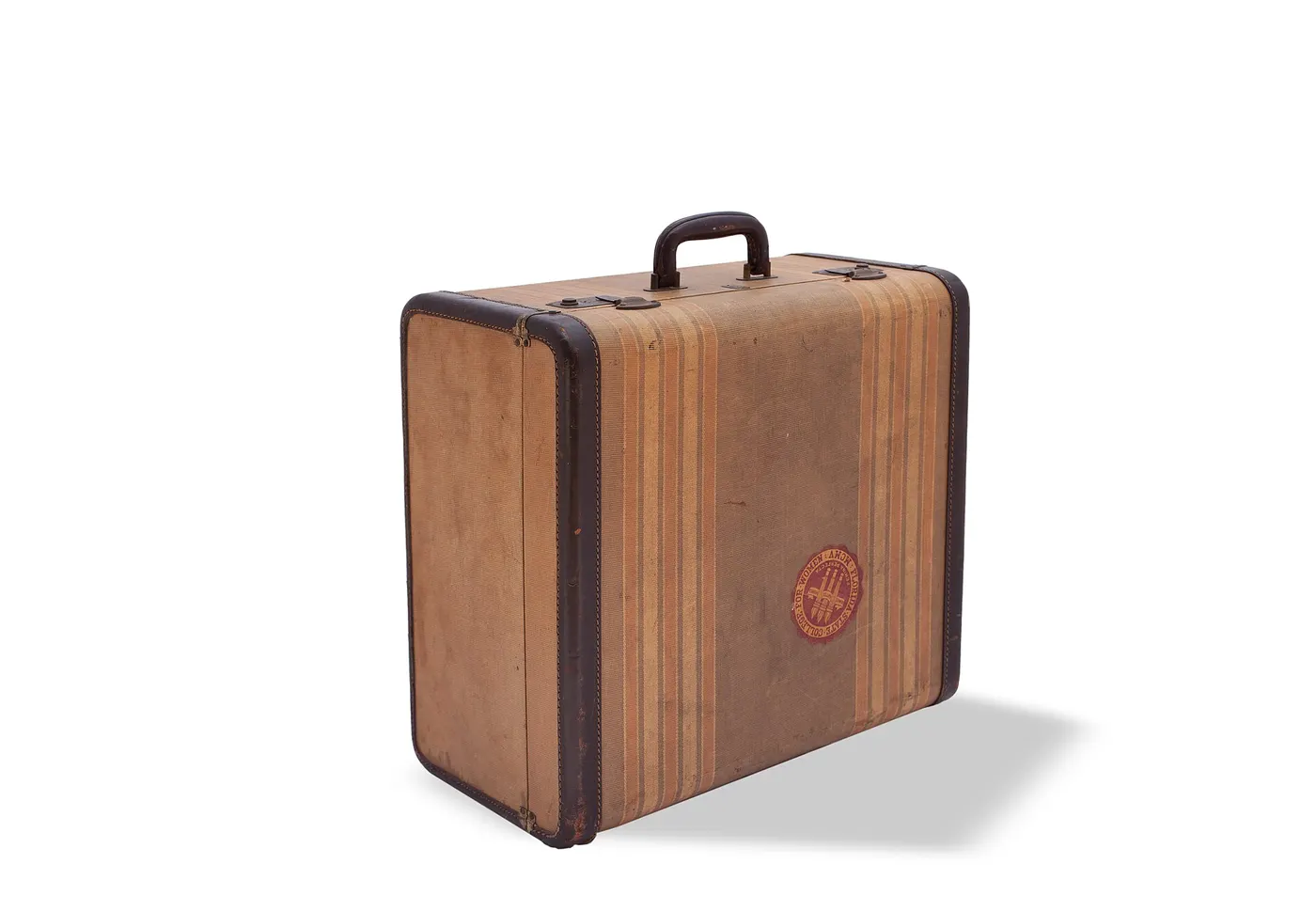
Two wheels or four, and what the route decides
Four-wheel spinners roll upright and steer with a fingertip on smooth terminal floors, which is most of an airport. They are worse on anything uneven, because the small castors catch on paving joints, cobbles and kerbs, and the case has to be dragged on two of them anyway.
Two-wheel cases are dragged at an angle on larger, recessed wheels. They handle a wet pavement, a station ramp and a kerb better, they are harder to knock sideways on a train, and the wheels sit inside the shell where they are less likely to be snapped off in a hold.
Decide by the worst 10 minutes of your usual journey rather than by the best. A commuter who walks 800 m on paving to a station and then wheels along a terminal is on the two-wheel side of the line; someone driven to a terminal door is on the four-wheel side. Wheel replacement is also worth a question in the shop, because a case with replaceable wheels on a bolted axle can be repaired and a riveted one usually cannot.
| Your usual route | Better choice | Why |
|---|---|---|
| Car to terminal door, smooth floors throughout | Four wheels | Upright rolling, no load on the wrist |
| Walk to a station, train, then terminal | Two wheels | Larger recessed wheels clear kerbs and paving joints |
| Cobbles, gravel or stairs at the far end | Two wheels | A dragged case is controllable on uneven ground |
| Frequent hold checking | Two wheels | Recessed wheels are less exposed to handling damage |
The arithmetic of being caught at the gate
The CAA notes that charges for placing an oversized bag in the hold at the airport are typically higher than fees paid at the time of booking. Suppose an airline's gate charge is £50, used here purely as an example since each airline publishes its own. Being caught twice in a year costs £100.
Against that, a £140 case kept 5 years costs £28 a year. A single year of gate charges on two flights is more than three years of owning the right case. That is the whole financial argument for buying to the tightest airline on your list rather than to the most generous one.
The second half of the argument is time. Repacking at a desk, moving items into a coat and queueing to pay takes a wholly avoidable 15 to 20 minutes, usually at the point in a journey where you have the least of it.
A shortlist you can finish in one shop visit
Five checks settle it: external height over wheels and handle, width and depth as packed, empty weight on scales, wheel type matched to your route, and whether the wheels and handle can be replaced. None of them needs a review, a rating or a test result.
The sixth check is the one people skip. Lift the case to shoulder height with one hand, the way you will when putting it into a locker. A case you cannot comfortably raise when empty will not be easier at 10 kg, and that is the single commonest reason a well-reviewed case gets replaced inside 2 years.
- Measure height over the wheels and the retracted handle, not the body alone
- Measure width and depth with the case packed, including a full front pocket
- Weigh the case empty and subtract it from your allowance
- Pick wheels for the worst 10 minutes of your route
- Ask whether the wheels and the handle are replaceable parts
- Lift it to shoulder height in the shop with one hand
Before you buy
- Pick the tightest airline you fly more than twice a year and buy to that size
- Measure external height over the wheels and the retracted handle
- Measure width and depth with the case packed, over a full front pocket
- Weigh the empty case and subtract it from the allowance before planning what to pack
- Choose wheel type by the roughest ground on your usual route
- Confirm the wheels and telescopic handle are replaceable parts
- Avoid an expansion zip if you fly to a hard cabin limit
Questions readers ask
- Is there a standard UK cabin bag size?
- No. The CAA's passenger guidance states that the amount and sizes of hand baggage vary according to the airline and aircraft type, and that some airlines will not let you carry a handbag in addition to your cabin bag. The practical answer is to buy to the tightest airline you use regularly and confirm the numbers on the airline's own booking page before each trip.
- Do the wheels really count towards the size?
- Yes, when the airline measures with a gauge at the gate, because the gauge takes the outside of the case as it stands. Measure from the floor under the wheels to the top of the retracted handle. A case advertised on body dimensions alone can be several centimetres larger than its listing once wheels and handle housing are included.
- Is a hard shell or a soft case better for the cabin?
- For the cabin, the deciding factor is usually empty weight rather than shell type, because the case is in a locker rather than under a loader. A soft case gains depth when it is full, which can fail a gauge; a hard case holds its measured size but weighs more. Weigh both empty and measure the soft one packed.
- How much does being caught at the gate cost?
- The CAA notes that charges for gate-checking an oversized bag are typically higher than fees paid at booking, and each airline sets its own. On an example £50 charge, two incidents in a year is £100, against £28 a year for a £140 case kept 5 years. The case is the cheaper purchase by a wide margin.
Sources
- UK Civil Aviation Authority — Checking your baggage allowance (hand baggage varies by airline and aircraft type) — checked 2026-11-03
- GOV.UK — Hand luggage restrictions at UK airports — checked 2026-11-03
Advertising is not enabled on this site yet. When it is, ads will be labelled and kept visually separate from the guides.